
ExoIQ
Smart Ergonomics for Modern Industrial Workplaces
Efficient fastening – reduced physical strain.
The combination of high-performance GESIPA® riveting tools and exoIQ’s body-supporting exoskeletons ensures ergonomically optimized industrial fastening technology.
exoIQ GmbH was founded in Hamburg in 2017 and is part of the
TTS-Festool Group. The company's goal is to support people in industrial workplaces with intelligent exoskeletons
and reduce physical strain—especially during overhead work or when working in awkward positions. Research and development take place in Hamburg, while production is based in Bavaria.

Project Details
- Category:
Ergonomics / Workplace Optimization - Project:
Use of active exoskeletons to reduce physical strain during - riveting work and assembly processes
- For more information:
exoIQ
The Challenge
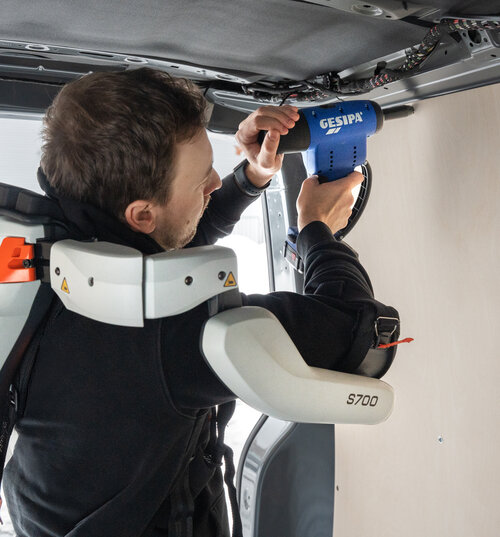
Assembly work using riveting tools, especially in overhead applications or hard-to-reach areas, places high demands on precision, repeatability, and physical endurance.
Especially with heavy equipment, repeated handling leads to fatigue and long-term health risks for the musculoskeletal system.
The combination of GESIPA® tool technology and exoIQ exoskeletons offers an intelligent solution for maximum performance with minimal strain.
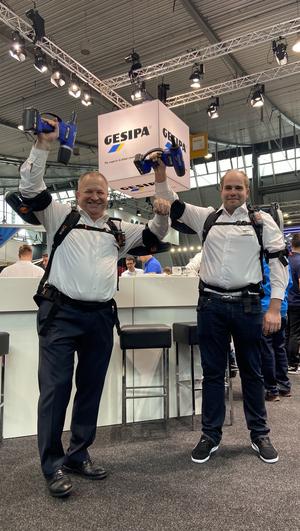
Stronger Together:
GESIPA® riveting tools and exoskeletons from exoIQ
The S700 active shoulder exoskeleton provides targeted relief: It actively supports the arms, takes over static holding tasks, and thereby noticeably reduces muscle strain. The result: Less fatigue, consistently high precision, and a significantly lower risk of long-term damage.
GESIPA® tools are designed for intensive, continuous use in industry and trade. When combined with an exoskeleton, physically demanding tasks can be performed longer, safer, and healthier—ideal for assembly lines and applications with high repetition rates.
At trade shows and events, we demonstrate how the combination of the S700 active shoulder exoskeleton and our riveting tools brings challenging overhead applications to life in a realistic setting. This clearly illustrates how ergonomic relief, high precision, and optimized assembly processes work together perfectly.
Products Used
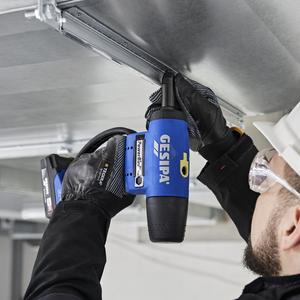
- GESIPA® Cordless Riveting Tools (for flexible applications and overhead work)
- AccuBird Pro CAS
- PowerBird Pro GE CAS
- FireBird Pro (S / GE) CAS
- iBird Pro CAS
- exoIQ S700 Shoulder Exoskeleton (active support for static holding tasks)
- exoIQ B900 Back Exoskeleton (for lifting tasks and forward-leaning postures)
exoIQ GmbH was founded in Hamburg in 2017 and is part of the TTS-Festool Group. Our mission: to support and empower people in industrial workplaces and protect them from physical injury. We develop intelligent support systems that positively transform the future of work—ergonomically, efficiently, and sustainably.
With roots in a university research project at Helmut Schmidt University, we have been conducting research on exoskeletons since 2014. Today, we employ over 30 people and are committed to “Made in Germany”: development in Hamburg, production in Illertissen (Bavaria).

GESIPA® has stood for the highest quality, innovation, and precision in blind riveting technology since 1955. As part of the globally active SFS Group, we develop and manufacture high-quality riveting tools, blind rivets, and blind rivet nuts for industrial applications—with a focus on the needs of specialty retailers, industry, and the automotive sector.
Our products are “Made in Germany” and used worldwide whenever reliable, durable, and process-secure connections are required. We offer not only tools but also complete system solutions—from consultation to after-sales support.

Technology that connects—and relieves strain.
Working overhead with riveting tools places a heavy physical strain on the body—especially when using heavy equipment on a regular basis. The S700 active shoulder exoskeleton specifically relieves strain on the arms and shoulders, reduces fatigue, and prevents long-term discomfort.
When combined with the wireless GESIPA® battery-powered riveting tools, the result is an ergonomically designed unit: greater stability, greater precision, and less physical strain—for efficient and healthy assembly processes.
