
Hand rivet tool
vs.
battery riveting tool
Which is better?

Working with blind rivets is one of the most efficient methods of joining metal parts. Whether in professional trades or DIY projects – blind rivets are indispensable in many areas. But the right tool makes all the difference.
Should you use a classic hand riveter or invest in a battery riveting tool? Both tools have their advantages and disadvantages. This article will show you which tool is best suited to your requirements.
Contents
What is a hand rivet tool?
What is a battery riveting tool?
Hand rivet tool vs. battery riveting tool – important comparison factors
When is which tool more worthwhile?
Conclusion and recommendation
Frequently asked questions
What is a hand rivet tool?
A hand rivet tool is a mechanical tool that has been specially developed for setting blind rivets.
The mechanism is simple: by manually squeezing the grip, the tool tightens the mandrel until the head of the blind rivet deforms and fixes the connection. You don't need any electricity or batteries – just muscle power and the right set of tools.

Varieties of hand rivet tools:

1. Small standard pliers: Models such as the NTX or NTS are light and compact. They are perfect for simple DIY jobs with small blind rivets.

2. Lever riveting tools: One example is the HN2, which requires less force thanks to extended lever arms and is ideal for larger blind rivets.

3. Lazy tong rivet tools: the SN2 has a special mechanism that further reduces the force required.

4. Ratchet riveting tools (e.g. Flipper): these innovative tools set the rivets in several steps, thereby ensuring optimal force transmission.

5. Combination tools: Tools such as the Flipper Plus not only set blind rivets, but also blind rivet nuts – a practical all-in-one tool.
Advantages and disadvantages of hand riveting tools:
| Advantages | Disadvantages |
|---|---|
| Cost-effective: A hand riveting tool is significantly cheaper than a battery-powered riveting tool. | Strenuous:The amount of force required increases with the number and size of the blind rivets. |
| Light and compact: Ideal for DIYers who don't have much space in their toolbox. | Time-consuming: Manual work is slower than with a battery-powered blind rivet tool. |
| Independent of electricity or batteries: Mechanical tools always work, with no charging times. | Limited power: Setting large or very many blind rivets in succession is tedious. |
| Versatile: With the right set, you can use different sizes of blind rivets. |
Applications of hand riveting tools
Hand riveting pliers are the perfect choice for DIYers or occasional users.
Whether it's small metalwork or repairing everyday objects, this simple tool is indispensable for smaller projects.
What is a battery riveter?
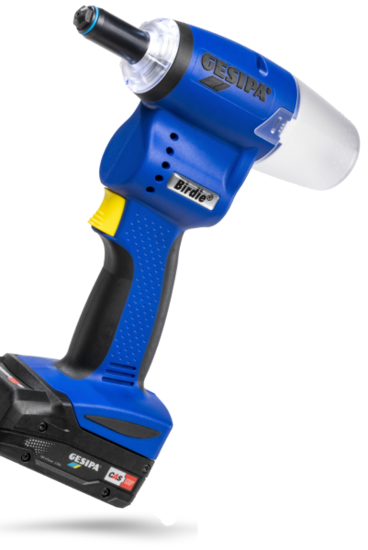
A battery riveter automates the setting of blind rivets. The motor in the tool pulls the mandrel and forms the blind rivet in seconds – without any physical effort.
The energy comes from a rechargeable battery, which is often compatible with other tools from the same manufacturer.
At GESIPA, all tools are compatible with CAS (Cordless Alliance System) batteries. This means that we can guarantee that our tools are compatible with a battery that saves resources but still delivers the power you need.
Varieties of battery riveting tools:

Compact models: The Birdie is light and handy, perfect for small projects and mobile bits of work.

App-controlled tools: The iBird® Pro lets you monitor and optimise riveting processes via an app – an innovative tool for technology lovers

Tools for large blind rivets: The PowerBird® Pro Gold Edition is powerful and designed for demanding applications.
Advantages and disadvantages of battery-powered riveting tools
| Advantages | Disadvantages |
|---|---|
| Saves energy: You can set rivets without physical exertion. | Initial costs: Investing in a battery-powered riveting tool costs more than a hand rivet tool |
| Efficient: Working with a battery-powered riveting tool is faster. | Weight: The tools are often heavier, especially the larger models. |
| Versatile: Accessories such as extension units and angle heads make the tool extremely flexible. | Dependency on the battery: A flat battery can interrupt your work. However, with the CAS system from GESIPA, you get batteries of the highest quality and durability. |
| High quality: GESIPA guarantees long-lasting batteries, robust workmanship and a very long repair life. |
Areas of application for battery riveters
A battery riveter is ideal for professional users and larger projects.
It shows its strengths when many rivets have to be set in a short time or when the work has to be particularly precise and comfortable.
Hand rivet tool vs. battery riveting tool – important factors to compare
Effort and ease of use
Hand rivet tools require more force, which can be tiring when used intensively. A battery riveting tool does the work for you and offers maximum comfort – ideal for longer or repeated bits of work.
Time saving and efficiency
When setting blind rivets, a battery riveter saves you valuable time. For occasional jobs, the hand rivet tool may still be sufficient, especially for smaller projects.
Mobility and flexibility
The hand rivet tool is light, compact and independent of power or batteries. But modern battery riveters offer amazing flexibility thanks to accessories such as extension units and angle heads – even hard-to-reach places are no problem.
Costs and price-performance ratio
Hand rivet tools are affordable and low-maintenance, while battery riveting tools require a higher initial investment. However, for regular or professional use, the price-performance ratio of a battery-powered tool is often better.
Maintenance and durability
Mechanical tools such as hand rivet tools require less maintenance and have a long service life. On the other hand, battery-powered tools like the GESIPA battery-powered riveting tool require occasional battery changes, but thanks to high-quality batteries, they offer a long operating time.
When is which tool worthwhile?

Small DIY projects
The hand rivet tool is perfect for DIYers who work occasionally. With a suitable set, you can process all common blind rivets – without much effort.

Professional applications
If you need to carry out intensive work on a frequent basis, a battery-powered riveting tool from GESIPA is the right choice. It offers speed, convenience and versatility.
However, battery-powered tools also have their limits – for heavy daily use, we recommend pneumatic systems such as the TAURUS.

Budget considerations
If you only work occasionally, the hand riveting tool is the more economical solution. However, if you are planning in the long term, a battery riveting tool will save you time and energy.
Conclusion and recommendation
Whether you need a hand rivet tool or a battery riveting tool – both products have their place in the toolbox. DIYers use hand rivet tools to work cost-effectively and flexibly. Professionals invest in a battery riveting tool to work efficiently and with less effort.
The choice depends on your needs: How often do you work with blind rivets? What projects are you planning? How important are comfort and efficiency to you?
With GESIPA as your partner, you are guaranteed to find the best tools, accessories and solutions for your requirements.
Frequently asked questions
Can I use a battery riveter to work in hard-to-reach places?
Yes, you can use a battery riveter to work in hard-to-reach places. Modern tools offer a wide range of accessories that have been specially developed for such applications.
Extension units allow you to reach deeper points. Angle heads help you to set rivets in narrow or angled areas.
Brands like GESIPA offer battery riveters with a wide range of customisation options. These tools are ideal if you want to work flexibly.
Even complicated tasks can be completed efficiently and with little effort. Be sure to select the right accessories for your tool to get the best possible results.
How do I properly care for and maintain hand riveting tools?
To keep your hand rivet tool in perfect condition, you should clean it regularly. After each bit of work, remove dirt, metal shavings and dust with a dry cloth. Make sure that all moving parts remain free of debris.
Occasionally lubricate the joints and mechanism with a suitable lubricant. This ensures smooth operation.
Check the jaws regularly for wear and replace them as needed.
Store the pliers in a dry place to prevent rusting. With this care, your hand riveting pliers will last a long time and be ready for use.
Which brand offers the most durable and best tools for blind rivets?
GESIPA is considered a leading manufacturer of high-quality blind rivet tools. The company offers a wide range of products that are known for their durability and reliability.
Whether you are looking for hand riveting tools or battery-powered riveting tools, GESIPA manufactures tools that are suitable for both DIYers and professional users.
The combination of innovative technology and robust design ensures a long service life and efficient working.
